
Getting Married in Ireland: Legal Requirements
In the Republic of Ireland, you must give at least three months’ notice of your intention to marry. The three-month period begins from your marriage notification appointment with the Registrar, so we recommend starting the process well before the minimum deadline.
No. You do not need to travel to Ireland in advance of your wedding. The required paperwork can be submitted remotely, so most of the legal process can be completed from home.
If you are having a legal marriage in Ireland, you will need to meet with the Registrar in person, but this can usually be arranged for a few days before your wedding, when you are already in Ireland for your wedding trip.
We help connect our couples with the appropriate local Registrar and guide them through the process, making it straightforward to plan a legal wedding in Ireland from the USA, Canada or elsewhere.
A legal ceremony is performed by a registered solemniser (civil, religious, or secular) and includes the paperwork that makes your marriage official. A symbolic ceremony — including a Celtic handfasting or vow renewal — carries no legal weight, giving you full freedom over location and script.
Yes. US and Canadian citizens can legally get married in Ireland, and you do not need to be an Irish citizen or resident. You must follow the legal marriage requirements for the part of Ireland where your ceremony takes place. The Republic of Ireland and Northern Ireland have separate marriage processes, so it is important to follow the correct requirements for your wedding location.
Valid passports, original birth certificates, proof of address, your ceremony venue and solemniser details, and your two witnesses’ names and dates of birth. If either of you was previously married, divorced, or widowed, additional documentation is required.
No. There’s no residency or citizenship requirement. You’ll pay a marriage notification fee (currently €200) at your appointment.
Yes — Northern Ireland is part of the UK, so the process differs from the Republic. Notice period is 28 days minimum (up to 12 months ahead), with a fee of £22 per person, submitted separately by each partner. Americans and Canadians typically need a Marriage Visitor visa, plus a UK ETA to enter. See our Northern Ireland legal guide.
A legal marriage performed in Ireland is generally recognized in the USA and Canada, provided it was legally valid in Ireland. After your ceremony, make sure your marriage has been properly registered and obtain the appropriate marriage certificate. Requirements for changing your name or updating government records after returning home can vary by country, state or province.
Most couples spend between €2,400 and €9,000+. €2,400–€3,500 covers a simple couple-only elopement; €3,500–€5,500 gets a professionally planned elopement with greater location choice; €5,500–€9,000+ is a comprehensive experience with hair and makeup, flowers, videography, music, and chauffeur included.
Starting from €2,400, Lite packages are built specifically for couples eloping alone, without guests — covering the ceremony location, photographer, planning, and location fee.
Yes — photographer, videographer, celebrant, hair stylist, makeup artist, florist, chauffeur, ceremony musician, reception venue, accommodation, and guest transportation are all optional add-ons.
It depends on the package. There is no standard definition of an “all-inclusive” Ireland elopement package. Always check whether the quoted price includes planning, location fees, photography, celebrant, flowers, hair and makeup, videography, transportation, music, weather backup, taxes and guest charges. Our packages clearly show what is included, and optional services can be added depending on the experience you want.
Our Lite Elopement Packages (from €2,400) include the ceremony location, photographer, planning service, and applicable location fee. Location-specific packages add more — our Cliffs of Moher package (from €3,500) also includes private clifftop access, indoor weather backup, celebrant, and Celtic handfasting.
Videography, hair and makeup, flowers, transportation, live music, and legal marriage registration are the main cost drivers beyond your core package. Flights and accommodation are booked separately.
You pay each vendor directly, so all costs are clear and transparent. We’ll recommend and coordinate your trusted wedding vendors, confirm availability, and guide you through the booking process. Each vendor will provide their own payment details and terms, while our Ireland-based planning team coordinates everything to make the process simple and stress-free from overseas.
The budget for a small destination wedding in Ireland depends mainly on your guest count, ceremony location, vendors, accommodation and reception plans. A couple-only elopement can start from €2,400 with Eloping in Ireland, while a small wedding with guests will usually require additional budgeting for food, accommodation, guest transportation and venue costs.
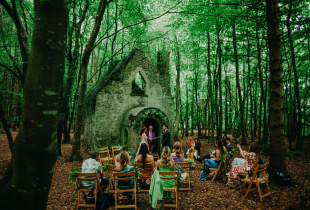
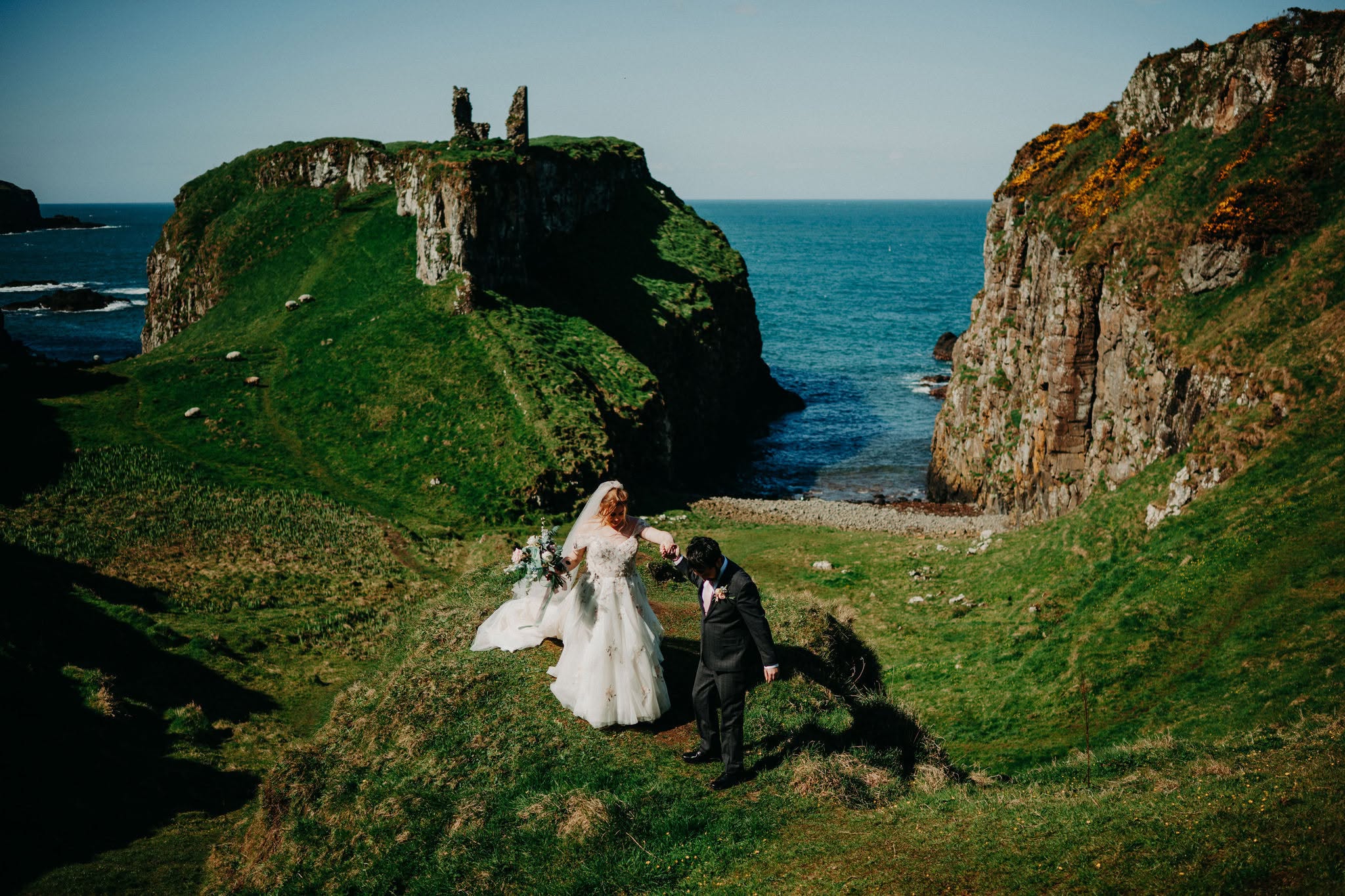
Favourites include the Cliffs of Moher, Dunluce Castle on the Causeway Coast, the remote Three Castle Head, Howth Cliffs near Dublin, and the 19th-century roofless Dunlewey Church beneath Mount Errigal.
Yes — our Cliffs of Moher package includes private drive-up access, and more remote spots like Kinbane Castle or Three Castle Head offer even greater seclusion.
An indoor weather backup is built into our location packages by default, so a rainy forecast never derails your day.
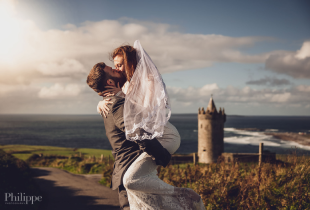
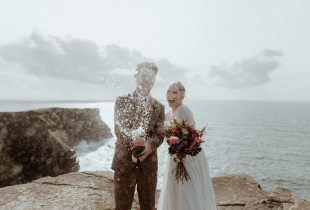
Yes. You can have an elopement or intimate wedding at the Cliffs of Moher. We use a spectacular private clifftop location at Hags Head with drive-up access, avoiding the busiest public visitor areas. Our Cliffs of Moher packages also include an indoor weather backup.
Cliffs of Moher gives dramatic clifftop views with private drive-up access. Castles like Dunluce sit above the Atlantic with photogenic backdrops. Ancient ruins feel intimate and secluded. Stone circles suit a Celtic handfasting with minimal setup.
Some locations, like Three Castle Head, require a short walk through the landscape; others, like the Cliffs of Moher, offer private drive-up access. Tell us your group’s needs and we’ll match a location.
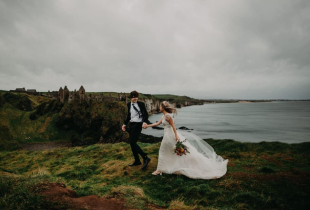
Yes. Dunluce Castle on Northern Ireland’s Causeway Coast is one of our most popular elopement locations. Couples can have an intimate ceremony with spectacular castle and Atlantic views, followed by photography around the Causeway Coast. Because Dunluce Castle is in Northern Ireland, different legal marriage requirements apply than in the Republic of Ireland.
Planning Your Elopement From Overseas or Ireland
Yes. We plan elopements and small weddings in Ireland for couples living anywhere in the world, including couples who already live in Ireland. Many of our couples travel from the USA and Canada, but we also work with Irish couples, couples from the UK and Europe, and couples based in countries around the world. You do not need to live overseas to use Eloping in Ireland — if you are an Irish couple planning a small wedding or elopement in Ireland, we would be delighted to help too.
We recommend 9–12 months ahead, giving comfortable time for legal notice, vendor availability, and travel planning. Simpler, off-season, couple-only elopements can sometimes be arranged faster.
Because our planning team is based in Ireland, we can respond locally to issues such as changing weather, road closures or unexpected vendor problems. Outdoor packages also include an indoor weather backup, and we build flexibility into the wedding-day timeline wherever possible.
No. Most of our international couples plan their Ireland elopement without making a separate planning trip. Location selection, vendors and wedding-day arrangements can usually be handled remotely with your Ireland-based planner. If you are having a legal marriage, you will still need to complete the required marriage notification process and attend the applicable appointment (a few days before your wedding).
Your Ireland-based planner has explored every location first-hand and has established relationships with trusted photographers, celebrants, and florists — so you get experienced recommendations, not guesswork, over video calls and email.
Flights, accommodation, personal legal documents, and attire. We handle locations, vendors, permits, and on-the-ground logistics.
No, but an Ireland-based wedding planner can make planning from overseas considerably easier. A local planner can help with ceremony locations, trusted vendors, timelines, transportation, weather alternatives, guest logistics and the legal marriage process. This is particularly useful for couples planning from the USA or Canada who may never have visited their wedding location before.
Dublin Airport for Dublin/Wicklow, Shannon Airport for the Cliffs of Moher/Galway/west coast, Cork Airport for southern Ireland, and Belfast airports for Dunluce Castle and the Causeway Coast.
We recommend 7–14 days — enough to recover from the flight, attend any legal appointment, enjoy your wedding day, and explore afterward.
Absolutely — most couples do. Extending your stay to explore beyond your wedding location is easy to build into your itinerary.
Yes. An Ireland elopement can be just the two of you or include family and friends. We regularly plan intimate weddings with small guest groups. Your guest count can influence which ceremony locations, transportation options, accommodation and reception venues work best, so it is helpful to decide approximately how many people you would like to bring before choosing your location.
US and Canadian citizens need only a valid passport for stays up to 90 days in the Republic. Visiting Northern Ireland requires a UK ETA, and marrying there typically requires a Marriage Visitor visa.
Ireland drives on the left and most rental cars are manual. The Republic uses the euro (€); Northern Ireland uses pound sterling (£). Rural roads can take longer than distances suggest.
There is no single limit. Some locations work best for just the couple or a handful of guests, while castles, country houses, ancient ruins and pub weddings can accommodate larger groups. We have planned everything from private two-person elopements to small destination weddings with family and friends, so we recommend choosing your location partly around your expected guest count.
Weather, Seasons & Your Wedding Day
There is no single best month to elope in Ireland. May through September offers longer daylight and generally milder temperatures, while spring and fall can bring fewer visitors and beautiful scenery. Winter offers greater privacy and dramatic landscapes but much shorter daylight. Ireland’s weather is changeable year-round, so we recommend choosing your date based on daylight, visitor levels and the experience you want rather than trying to guarantee sunshine.
It varies by season — summer gives the longest days and best light for photography, while winter has limited daylight. We plan your ceremony timing around the actual season.
Plan for it — Ireland’s weather can change quickly, sometimes across very short distances. Every outdoor package includes a scouted indoor weather backup.
Pack for changeable weather. See our wedding attire travel guide for how to pack and protect your dress or suit.
Wedding Vendors, Services & Irish Traditions
Photographer, videographer, celebrant or legal solemniser, hair stylist, makeup artist, florist, chauffeur, and ceremony musician are all available as add-ons to your package.
Traditional Irish music, Irish readings or poetry, Claddagh rings, Irish flowers, and a toast with Guinness or Irish whiskey are popular ways couples personalise their day.
An ancient ritual where your hands are bound together with ribbons or cords during the ceremony, symbolising your union.
Local, first-hand knowledge and established vendor relationships mean honest recommendations and problems solved before you even know about them. Read why an Ireland-based planner makes the difference.